
Dr. Ming Wang is an ophthalmologist with medical training at Harvard and MIT and a Ph.D. in laser physics. He developed the amniotic membrane contact lens, an invention for which he holds two U.S. patents. His foundation also provides sight-restoration surgeries free of charge to patients in need. What moved me most was the generosity behind his work. Dr. Wang shares how he choosing to donate the technology to the world, sharing his patent online and teaching other physicians how to use the technology free of charge. By sharing both the invention and the knowledge needed to apply it, he helped more physicians bring its benefits to patients around the world.
To me, this is true leadership: creating something that can change lives and helping others carry its benefits further. His humility and willingness to share reminded me that the purpose of medical innovation begins with the people who need it.
That example gave me a lens through which to consider the rapid development of AI in healthcare.
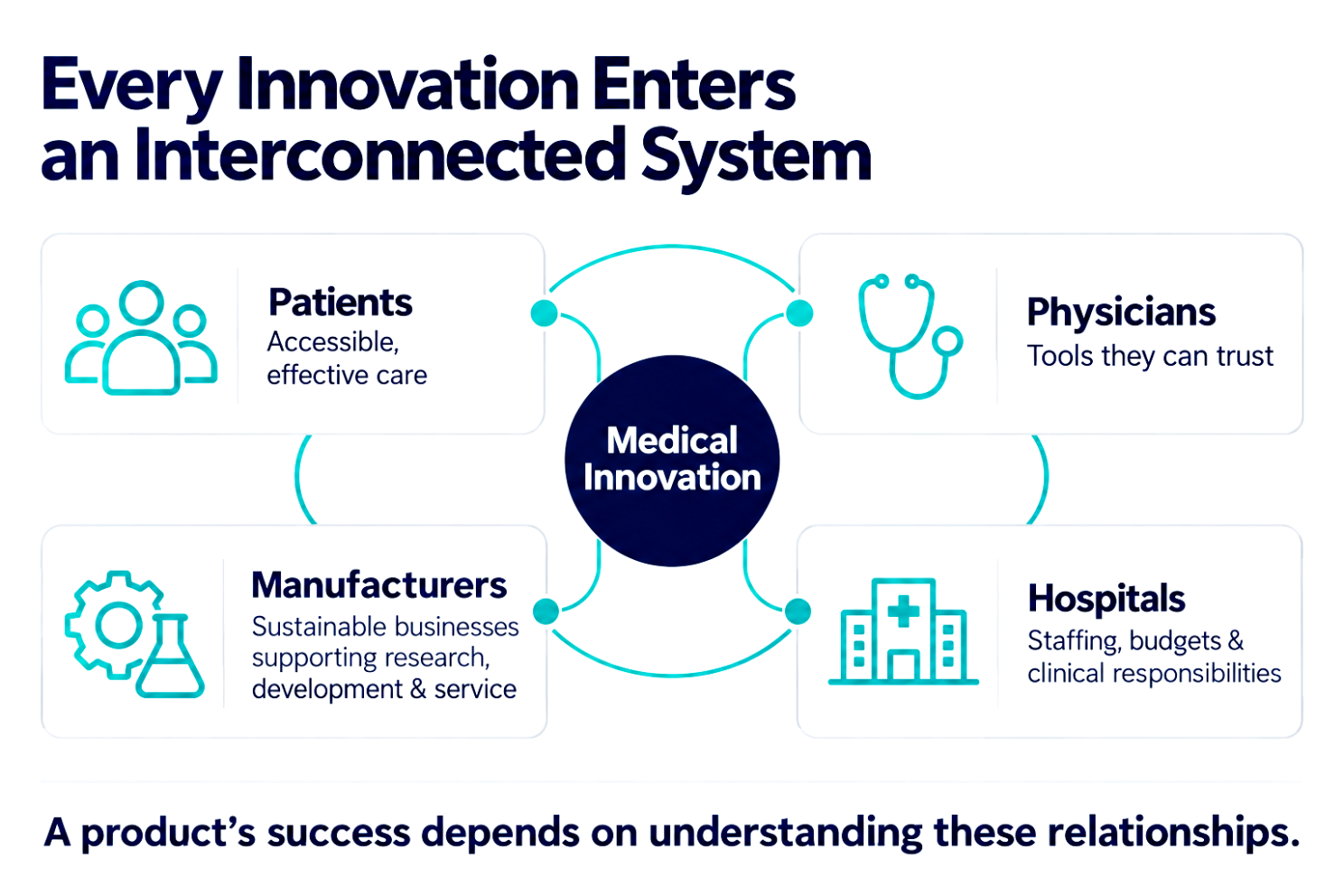
After more than 18 years in the medical technology industry, I have learned that every innovation enters an interconnected system. Patients need accessible, effective care. Physicians need tools they can trust. Hospitals must manage staffing, budgets, and clinical responsibilities. Manufacturers need sustainable businesses that support research, development, and continued service. A product’s success depends on understanding those relationships.
As AI expands what we can build, I believe we must become more disciplined about asking why we should build it.
Whose problem are we solving? What barrier are we removing? And how will we know that someone’s care has improved?
The need is already urgent. In its 2024 workforce report, the Association of American Medical Colleges projected that the United States could face a shortage of up to 86,000 physicians by 2036. The report also noted that 20% of the clinical physician workforce was already aged 65 or older, with another 22% aged 55–64. Those figures do not tell us exactly how many doctors will retire, but they show the scale of the workforce approaching or already beyond traditional retirement age. For patients, a workforce shortage can become a very personal problem: difficulty finding a doctor, a long wait for a specialist, or another journey away from home to receive care.
This is where technology deserves our attention. Could a carefully validated tool reduce administrative work and give clinicians more time with patients? Could it help identify patients who need urgent review? Could it connect local clinicians with specialist expertise or help researchers develop treatments for diseases that remain difficult to treat?
These are specific purposes against which a technology’s value can be tested. AI should be part of a broader response that also includes training, retaining, and supporting healthcare professionals.
The question of access became more tangible to me when I traveled Maui this summer. Maui only has one acute-care hospital. It provides emergency and specialty services, although some patients still require transfer off the island for care beyond local capabilities. When a patient’s needs are urgent, distance becomes more than an inconvenience—it can affect how quickly they receive appropriate care. That is why I see a real need for remote healthcare supported by AI where it can safely assist clinicians. Connecting local teams with specialists, sharing diagnostic information, and using validated AI tools to help flag time-sensitive findings could support faster assessment and decisions about treatment or transfer. These services cannot replace emergency surgery or an on-site care team, but they could help bridge the time between recognizing a problem and reaching the expertise needed to address it. That is a purpose worth pursuing—and measuring.
One lesson I took from Dr. Wang’s lecture was the importance of understanding a technology’s limitations before trusting its outputs. He explains that modern AI is a breakthrough defined by Jeffrey Hinton’s "bottom-up" approach, which limits individual neuron complexity to enable manageable parallel processing on Nvidia’s GPU hardware. This method is depicted as a paradigm shift similar to quantum mechanics, allowing for the simulation of the human mind despite current computing speed limitations. Dr. Wang stresses that users must understand these core principles to navigate the technology’s 20% error margin and avoid ethical pitfalls. The World Health Organization has warned that generative AI in healthcare can produce inaccurate, biased, or incomplete information, and that excessive reliance on these systems can cause users to overlook errors. WHO also emphasizes involving patients and healthcare professionals throughout development. For me, that means asking practical questions early. Does the tool work reliably for the patients who will actually use it? Can clinicians recognize and correct mistakes? Does it reduce their workload after implementation? Can the communities with the greatest need afford and access it?
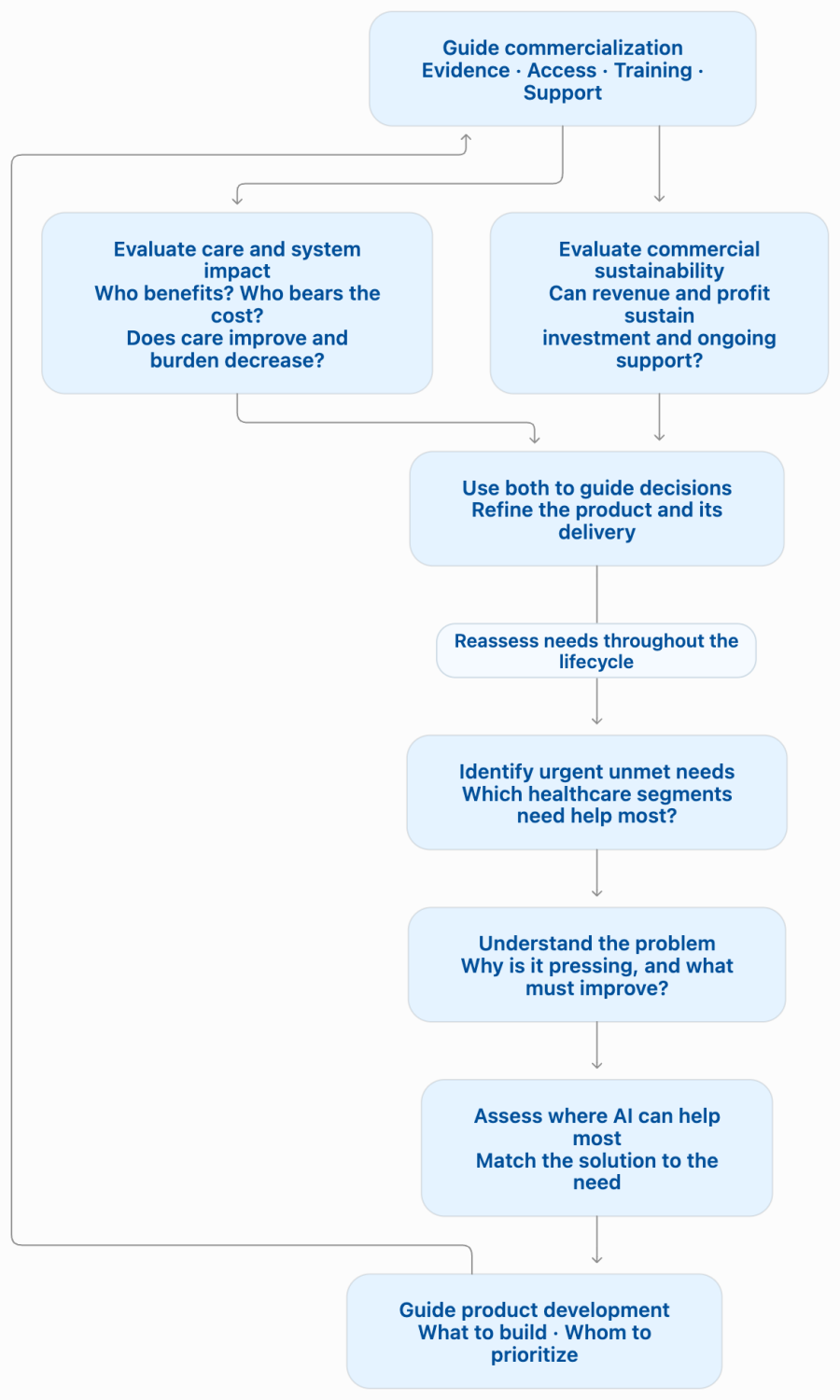
These questions belong at the beginning of product development and should continue to guide decisions throughout commercialization. We need to identify which healthcare segments face the most urgent unmet needs, understand what makes those problems so pressing, and determine where the AI solution can make the greatest difference. That understanding should shape what we build, whom we prioritize, and how we bring the product into clinical practice.
Commercial sustainability also matters. Bringing medical technology into practice requires investment, evidence, training, and ongoing support. Profit can sustain that work. But revenue alone cannot tell us whether an innovation improves care. We also need to examine who benefits, who carries the cost, and whether the product addresses a pressing need while making an already strained system easier to navigate.
What I appreciated about Dr. Wang’s example was the sense of responsibility behind the science: the desire to help patients and equip others to do the same.
That is the standard I hope we carry into healthcare AI.
Technical excellence remains essential. Its purpose becomes clear when we understand the person waiting for a diagnosis, the clinician struggling to meet demand, or the family traveling far from home for treatment.
The most compelling use case begins with a human need urgent enough to demand our attention. Our responsibility is to understand that need deeply, choose the right tools, and demonstrate that we have made a meaningful difference.
Before asking how advanced our technology can become, we should be able to explain whose life it will improve—and how.
Reference:
Association of American Medical Colleges. (2024, March 21). New AAMC report shows continuing projected physician shortage.